Client Challenge
In 2022, growing political tensions and public mistrust toward law enforcement meant every budget decision was under a microscope. For one metropolitan Police Service, the proposed 2022 budget was higher than 2021’s—a decision that faced immediate backlash from community groups aligned with Black Lives Matter and Defund the Police, who were calling for budget cuts.
The stakes were high: mishandling the narrative could deepen community divisions, damage trust, and inflame public opposition.
The Police Service needed to:
- Explain why the increase was essential.
- Avoid amplifying opposition voices.
- Prevent sensitive details from leaking to the press.
Traditional tools like surveys or focus groups were ruled out due to the risk of leaks and politicization.
Baseline Analysis
Polly measured existing public conversation and sentiment toward the Police Service.
While one-third of residents were supportive, opposition groups maintained a loud and coordinated presence.
|
|
Engagement per 100K |
Support |
Neutral |
Oppose |
|---|---|---|---|---|
|
Baseline |
750 |
35% |
37% |
27% |
Neutralize Engagement
The Police Service had 56 potential talking points for a press release, covering:
- Inflationary pressures on service delivery.
- Improving the work environment for women and minorities.
- New initiatives like community deployment—partnering with social and mental health organizations.
Objective: Identify which messages could shift opponents into neutral while growing support—reducing total engagement and letting the controversy fade.
Focus on Transparency
Polly’s hyper-local message testing revealed:
- Community deployment, especially mental health partnerships, was the most persuasive and least polarizing.
- Talking about inflation or workplace harassment often triggered opposition.
- Stating the budget increase to two decimal places (e.g., 2.37%) increased perceptions of transparency and credibility.
Most Successful Messaging
|
Message |
Support |
Neutral |
Oppose |
|---|---|---|---|
|
Budget to 2 decimal places |
60% |
40% |
0% |
|
Community Deployment |
55% |
45% |
0% |
|
Inflation |
33%
|
49% |
18% |
|
Sexual Harassment |
0% |
53% |
47% |
Neighborhood Breakdown
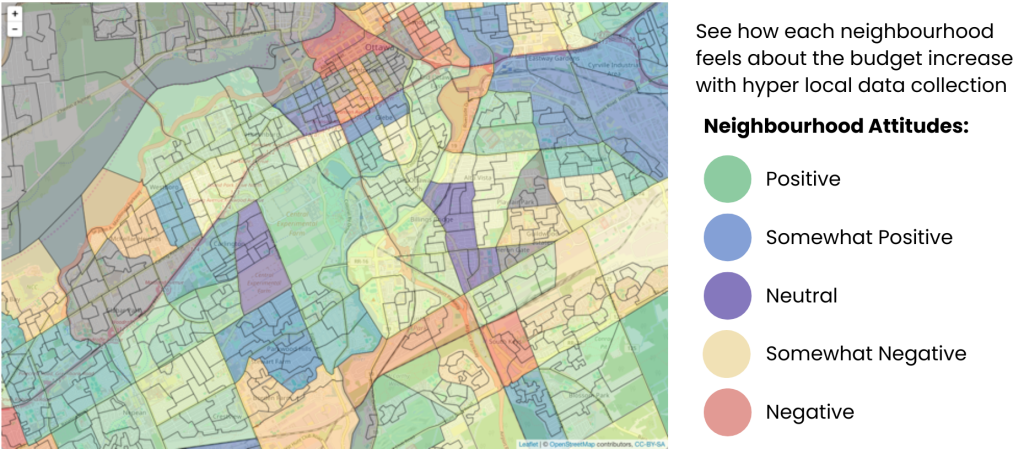
Using Polly’s hyper-local analysis, the Police Department was also able to break down sentiment towards their organization by neighbourhood, allowing for strategic communications and programs throughout the city.
Increase in Support 150%
The Police Service’s press release featured only the high-performing messages recommended by Polly. ASI monitored public sentiment for one month after launch.
The transformation was dramatic:
- Engagement fell by 400%—from 750 to just 180 per 100K.
- Support grew by 150%.
- Opposition dropped by 200%.
|
|
Engagement per 100K |
Support |
Neutral |
Oppose |
|---|---|---|---|---|
|
Before askpolly Message Testing |
750 |
35% |
37% |
27% |
|
After askpolly Message Testing |
180 |
53% |
36% |
11% |
Results
This case proves that Polly’s Message Testing can deliver measurable wins even in highly charged political environments. By focusing on the right messages:
- Engagement dropped sharply, allowing the controversy to fade.
- Support rose significantly without amplifying opposition.
- Sensitive information stayed protected.
In just one month, the Police Service shifted public sentiment and reduced political heat—without asking a single survey question or running a focus group.