A practical case study in message testing with conservative voters in Texas
Public-relations professionals are often asked a version of the same question:
Can you help us communicate with audiences who fundamentally don’t trust us?
Sometimes that audience is described as “hard-to-reach.” Sometimes as “hostile.” Increasingly, it’s framed more bluntly: Can you reach MAGA voters?
The short answer is yes.
The more honest answer is not without discipline.
At askpolly™, Polly was designed precisely for this problem: understanding how messages land with populations that are suspicious of mainstream media, resistant to institutional authority, and highly sensitive to perceived manipulation. But Polly does not replace human judgment. She tests it.
What follows is a real example of how communications strategy changes when you stop guessing—and start measuring.
The strategic mistake most communicators make
Many communicators assume that persuading conservative or pro-Trump audiences requires one of two approaches:
- Blunt opposition (“name and shame”), or
- Artificial alignment (“sound more conservative”)
Both approaches usually fail.
Why? Because the modern conservative media ecosystem is not organized around policy. It is organized around morality, distrust, and narrative conflict.
Three psychological realities matter here:
- Moral identity is central. Many conservative voters see themselves as moral actors in a corrupt world.
- Mainstream channels are distrusted by default. Messages perceived as “media talking points” are rejected instantly.
- Outrage travels through alternative influencers. Not through institutions, but through personalities and conspiratorial framing.
This means persuasion is not about changing values.
It is about activating existing values against a new target.
Using Immigration Enforcement as a Test Case
Immigration is often treated as a binary issue: pro-immigration versus anti-immigration. But Polly’s data consistently shows that this framing collapses nuance and hardens resistance.
Instead, Polly suggested a structural question:
Why are undocumented immigrants not being deported, but instead sent to detention facilities—sometimes outside the United States?
This question does three important things:
- It does not challenge the legitimacy of enforcement
- It appeals to fairness and justice
- It invites suspicion of institutional corruption
We first asked Polly to ask this question of a mainstream U.S. audience. One dominant narrative emerged:
Immigration detention has become a for-profit system, where taxpayer money flows through private or foreign detention facilities—creating perverse incentives that benefit political actors.
Whether one agrees with that narrative is not the point.
The point is that it exists, and it is coherent.
The next step was critical.
Testing the same narrative with Texas conservatives
Using Polly, we tested variations of this story against a conservative audience in Texas—a population often assumed to be unreachable on immigration messaging.
The results were striking.
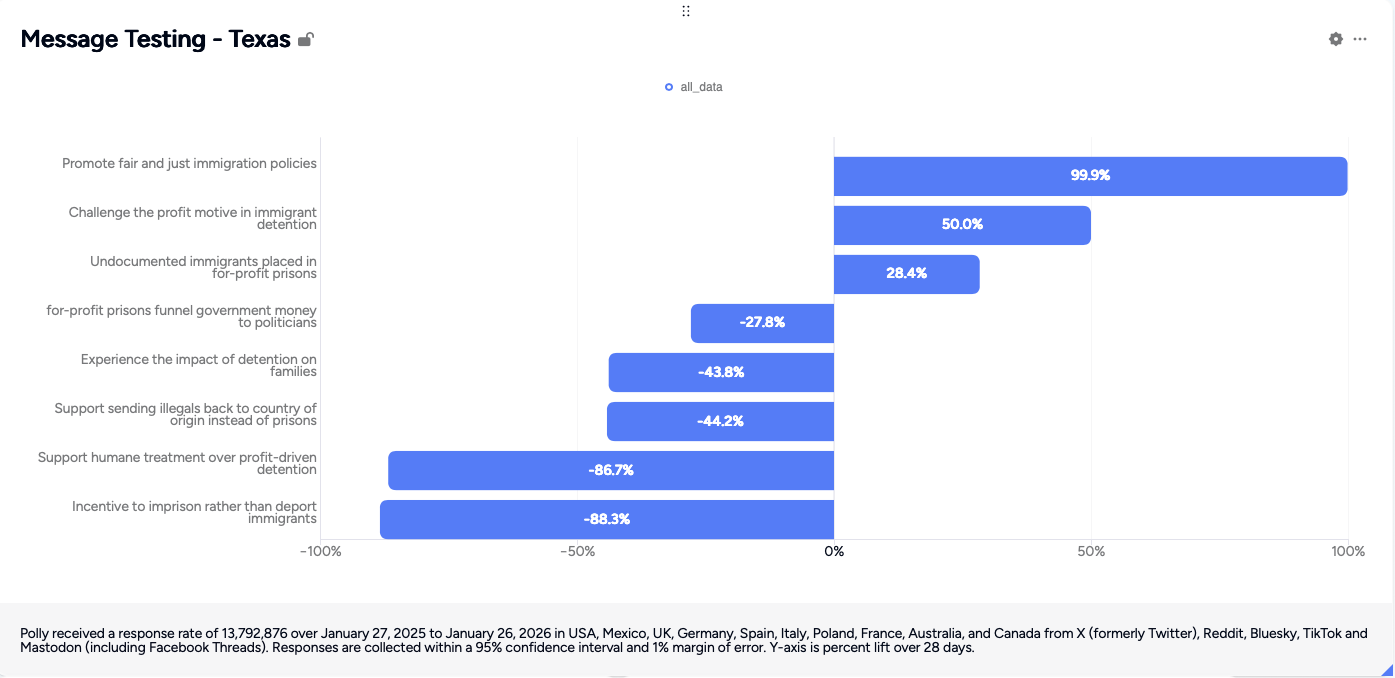
As shown in Chart 1 (below), certain frames generated extremely strong positive reactions:
- “Promote fair and just immigration policies”
- “Challenge the profit motive in immigration detention”
- “Reveal that immigrants are placed in for-profit prisons”
These messages didn’t soften conservative voters.
They activated them.
Why? Because they reinforced an existing moral belief:
The system is corrupt, and ordinary people are being exploited.
However, the same chart also reveals clear red lines.
Messages that emphasized:
- Detention harming families
- Calls for humane treatment
- Arguments framed around empathy over enforcement
…performed very poorly, triggering resistance rather than reflection.
The insight here is not ideological. It is tactical.
The sequencing matters more than the message
One of the most important discoveries Polly surfaced was this:
The same underlying claim can succeed or fail entirely based on attribution.
When the narrative suggested current conservative leadership was responsible, the message collapsed. It was perceived as partisan attack.
But when the narrative was reframed as:
A corrupt system created by prior administrations and entrenched interests—one that should be dismantled
…the message gained credibility.
This is not deception.
It is narrative sequencing.
You first establish shared moral ground:
- Fairness
- Justice
- Opposition to corruption
Only then do you introduce structural critique.
Why this works: the Trojan horse principle
This approach works because it follows a simple communications truth:
People will accept a destabilizing idea if it arrives inside a story that affirms their identity.
The message is not “your beliefs are wrong.”
The message is:
Your moral instincts are right—and someone is exploiting them.
For communications professionals, this is the difference between confrontation and conversion.
What Chart 1 actually tells a comms team
The attached graph is not just a visualization. It is a playbook.
It shows:
- Which moral frames to lead with
- Which facts to introduce later
- Which emotional triggers to avoid entirely
In practical terms, it allows a team to:
- Stress-test headlines before release
- Shape influencer-ready narratives
- Avoid catastrophic backlash while still challenging power
This is what Polly was built for.
The real takeaway for PR and communications leaders
The future of persuasion is not louder messaging or smarter copywriting.
It is measured narrative design.
Polly does not tell you what to believe.
She tells you what will land, with whom, and why—before you step onto the public stage.
In an era where trust is fractured and audiences self-select into parallel realities, that is no longer optional.
It is the job.