Why Unbiased Audience Sampling Is Now a Marketing Imperative
For two decades, marketers learned how to work with search engines.
Search engines point.
They send users elsewhere—blogs, reviews, forums, brand sites.
Responsibility for accuracy lives with the source.
That model is ending.
Large Language Models don’t outsource answers.
They issue recommendations.
When someone asks an LLM:
- Which pharmacy should I trust?
- Which brand is better?
- What matters most to customers like me?
The model doesn’t return ten blue links.
It returns a synthesized judgment.
And that changes everything.
The New Risk: Confident Answers Built on Biased Data
Because LLMs speak with authority, the quality of their underlying evidence matters more than ever.
Yet most systems still rely on:
- Social media chatter
- Reviews and forums
- Crowdsourced or scraped content
- Highly vocal, highly skewed populations
These sources don’t represent markets.
They represent who talks the loudest online.
Certain demographics dominate.
Certain opinions amplify.
Certain narratives repeat.
The result?
Recommendations that sound objective but quietly reinforce bias.
For marketers, this creates a dangerous blind spot:
- You may optimize messaging around features customers talk about
- While missing the drivers that actually influence behavior
- And training AI systems on distorted signals that scale those errors everywhere
Why Sampling Is the Hard Part (and the Missing One)
True market research has always known the problem isn’t analysis.
It’s sampling.
If your audience isn’t representative, the insight doesn’t matter.
That’s why traditional research relies on:
- Randomized sampling
- Statistically valid populations
- Controlled bias
- Known confidence intervals
But until now, that rigor has been slow, expensive, and disconnected from AI systems.
Enter askpolly + Microsoft Copilot
 +
+ 
askpolly brings scientifically valid audience sampling directly into the LLM era.
Through its integration with Microsoft Copilot, askpolly enables:
- Unbiased, population-level sampling
- Natural-language study creation
- Zero-shot research (no pre-training, no panels)
- Market-grade results in minutes—not months
This means LLM-driven insights are no longer based on who posts the most.
They’re based on real, representative customers.
A Simple Example: CVS vs Walgreens
Let’s say we want to understand how people choose a pharmacy.
Not what brands say matters—but what actually drives decisions.
Using askpolly, the study is created in plain language:
“How satisfied are you with your pharmacist?”
We define:
- A one-year date range
- Geography: United States (with the ability to drill down by state, city, or neighborhood)
- Two audiences created in free-form text:
- CVS Shoppers
- Walgreens Shoppers
No prebuilt panels.
No forced taxonomies.
No training data setup.
askpolly trains on the spot and returns results in under three minutes.
What the Biased Sample Says (and Why It Misleads)
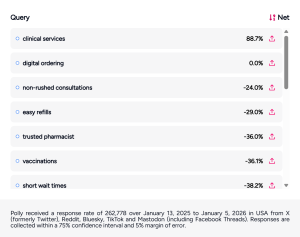
In the biased sample (Chart 1), CVS appears strongly associated with clinical services.
This aligns neatly with CVS’s own marketing narrative.
If you relied on this data alone, you’d conclude:
“Customers choose CVS because they want clinical care from pharmacists.”
That conclusion feels intuitive.
It’s also wrong.
What the Unbiased Sample Reveals
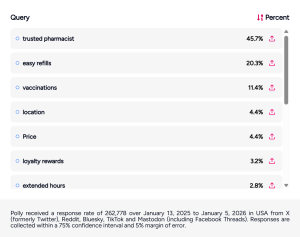
When we look at actual CVS customers, a different picture emerges (Chart 2).
Yes—people want to trust their pharmacist.
But clinical advice is not why they go to CVS.
What they actually value:
- Prescription accuracy (Trusted pharmacist)
- Clear guidance on medications and interactions
- Easy refills
- Convenient vaccinations
- Location convenience (CVS scores poorly on parking, notably)
Customers expect clinical expertise—but they want it reliable and efficient, not performative.
They get diagnosis and care from doctors.
They want pharmacies to remove friction from everyday health tasks.
Walgreens: Brand Promise vs Lived Experience
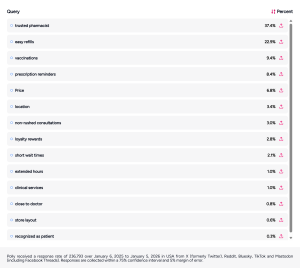
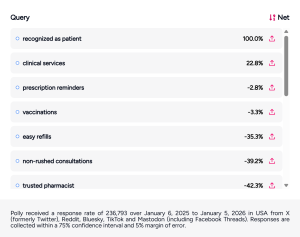
Walgreens’ marketing emphasizes recognizing customers as patients.
In the unbiased sample (Chart 3), customers recognize that intent—but score Walgreens lower on delivery.
Key gaps emerge:
- Lower ratings for easy refills
- Lower satisfaction with vaccinations
- Weaker performance on prescription reminders
Ironically, the more Walgreens promotes personalization, the more noticeable the inconsistency becomes.
From a competitive standpoint, the insight is clear:
To compete with CVS, Walgreens doesn’t need better messaging.
It needs operational improvement where customers already care.
Why This Matters for Marketers Now
This isn’t just a research story.
It’s an AI governance story.
As LLMs increasingly:
- Shape consumer decisions
- Inform product strategy
- Influence brand perception at scale
Biased inputs become amplified truths.
askpolly exists to prevent that.
It ensures that:
- What AI systems learn reflects reality
- What marketers optimize aligns with actual behavior
- What brands believe about their customers is grounded in evidence, not echo chambers
The Bottom Line
LLMs don’t browse opinions.
They distill them into decisions.
If those decisions are trained on biased samples, the error doesn’t stay small—it magnifies.
askpolly gives marketers something most AI systems lack:
A statistically sound mirror of the real market.
That’s no longer optional.
It’s the cost of being taken seriously in the age of AI-driven decision-making.